
Starry Nights by Petros Vrellis and Amoeba by George Toledo
Starry Nights is an interactive visualization of a famous Van Gogh painting in openframeworks
Amoeba is an organic and luminescent visualization of graphics being powered by random value generation
Voyagers – audio-visual installation for the National Maritime Museum in Greenwich
http://www.flightphase.com/main_wp/case-studies/case-study-voyagers
It is a detailed case study of ‘Voyagers’, a new permanent audio-visual installation for the National Maritime Museum in Greenwich. It shows readable text (based on texts in the museum collection) moving as waves and forming ocean like texture. Images and text changes in a continuous loop.
The case study has many video segments showing the work and also explaining the design and rendering and how the software tools were used.
NEPTUNE videos for projection segment
NEPTUNE CANADA videos suitable for projection (none has equipments or sensors visible, just marine life and they have adequate contrast):
Ghostly Skate on Juan de Fuca Ridge
http://www.neptunecanada.ca/news/multimedia-gallery/video/ghostly-skate.dot
1.46min
10 July 2011: While inspecting a cable lay over the rugged terrain of the Endeavour segment of Juan de Fuca ridge, we encountered this ghostly skate. This video was recorded by the remotely operated vehicle ROPOS at a depth of 2088m.
Water Column Creatures
http://www.youtube.com/watch?v=_2KAFWddyIs&list=UUjZBvvnoLb_5oKTPE723bCw&index=18&feature=plcp
1.47min
1 October 2010: We paused in mid-water (depth 1960m) to watch some of the strange and unusual creatures that dwell there
School of Sunfish
http://www.youtube.com/watch?v=ReZOYKhMDfk&list=UUjZBvvnoLb_5oKTPE723bCw&index=24&feature=plcp
1.42min
2 October 2010: We encountered a school of curious Ocean Sunfish (Mola mola), resembling luminous moons in the ocean night. (Depth: 21m)
Sea Pen and Sea Cucumber at 2660 metres
http://www.youtube.com/watch?v=0J9yetDtkTA&feature=BFa&list=UUjZBvvnoLb_5oKTPE723bCw&lf=plcp
1.49min
1 September 2009: A sea pen (Umbellula sp.) sways and a sea cucumber undulates in the bottom current near our ODP 1027 instrument platform.
Humboldt Squid in Barkley Canyon
http://www.youtube.com/watch?v=-dJApCY8xrE&feature=BFa&list=UUjZBvvnoLb_5oKTPE723bCw&lf=plcp
0.56min
This group of Humboldt Squid were observed feeding on small fish during a recent installation dive by ROPOS in Barkley Canyon. Location: 48.31036N, 126.0652W. Depth: 275 m
This video also could work well if it is accelerated even more:
Brittle Star Food Fight
http://www.youtube.com/watch?v=Myhp8ifW6ig&list=UUjZBvvnoLb_5oKTPE723bCw&index=37&feature=plcp
1.59min
While installing a science node at our Middle Valley location (2400m below sea level), the ROPOS pilot focused his camera on a scuffle over a dead shrimp. Ophiuroids, better known as brittle stars demonstrate their speed.
real time data visulization and TextDraw (gestural typography) – Travis Kirton’s work
Travis Kirton has been developing tools for Interactive real time data visualization and computational arts and he specializes in gestural, nonlinear typography.
He developed a prototype application, TextDraw that allows for the creation of typographic works through gestural interaction.TextDraw looks toward tangible-surface interaction and the idea that associating functions to gestures combined with new tangible tools will result in radically new methodologies for design, artistic and poetic expression of typographic works.
Using Text Draw Travis transformed an entire book (Alice in Wonderland) into a visual artwork using the entire text of the book:
http://www.postfl.com/artwork/aliceinavenir/
Creative Environment for Emerging Electronic Culture www.ce3c.com has some projects such as artists Derek Demassi and Greg Debicki who have begun developing their new project Swimming with Pask, at the CE3C lab with interesting interactive, real time data visualization. Swimming with Pask is a digital media performance/installation that uses software and technology to give bioluminescent algae creative agency, allowing it to perform audio/visual collaborative improvisations with their breath.
Disrupting Currents
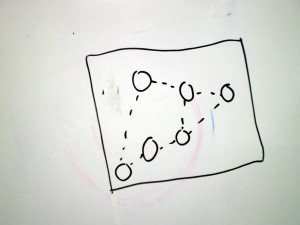
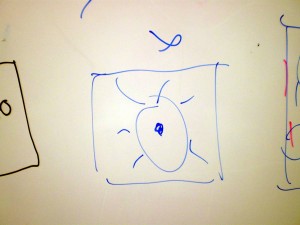
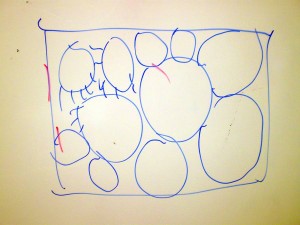
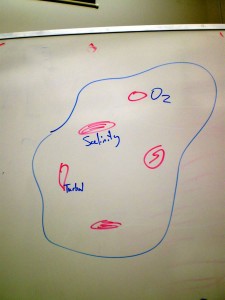
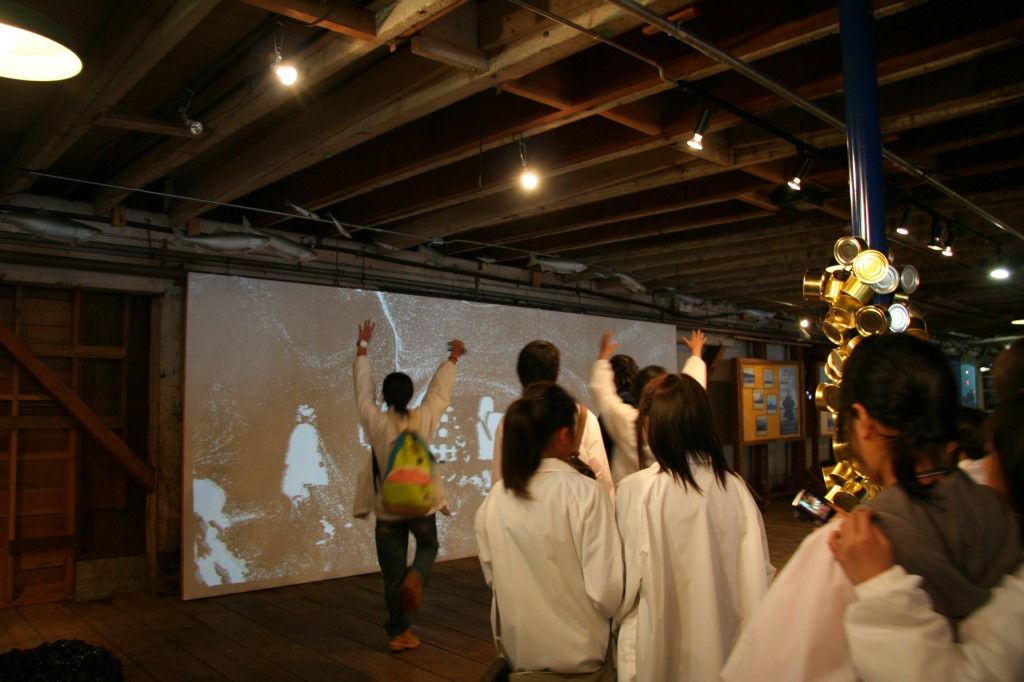 The projection “Disrupting Currents” displays ocean current patterns derived from real-time audio and other data such as measurement of current, temperature and oxygen from the nearby ocean historically rich in salmon. These dynamic interactive visualizations are visually and metaphorically “disturbed by ” by viewer presence and movement not unlike geological formations that change the course of water.
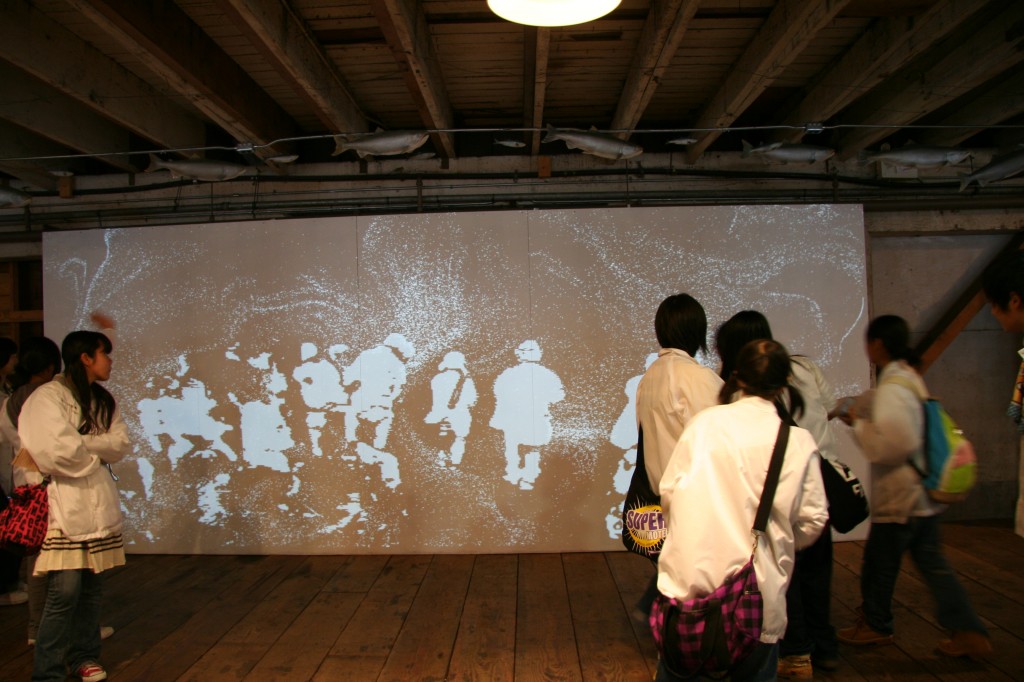
Steveston, Gulf of Georgia Cannery
Steveston is a small town that has become part of neighboring Richmond, a port city that has expanded exponentially over the past two decades as a result of globalization. Named after the first white family to settle in the region in the late 19th century, Steveston was the heart of the salmon industry in Canada, and considered, at one point, to be the “Salmon Capital of the World.” The Gulf of Georgia Cannery was one of the largest and westernmost canneries in the area until it closed in the 1970s. In 1993, it became a Parks Canada National Heritage Site open to the public.

The Gulf of Georgia Cannery is a monument to the massive iron machinery of the industrial era, as well as the men and women, and abundant fish that created the local community. Most of its gigantic equipment was left intact and on view for the public, surrounded by didactic panels, large scale black-and-white photographs and vitrines full of different scenes, such as models of the Cannery at different time periods, documenting the growth of the industry. The exhibition space where Ruth Beer, Kit Grauer, and Jim Budd installed Catch + Release runs parallel to the canning line, where people, mainly young women and ethnic minorities, stood in freezing cold temperatures for hours on end, receiving and processing the daily catch of salmon and herring. Above the line, which is now an archive of fishing artifacts, navigation, boat parts and equipment, children used to work feeding cans onto a rotating belt that dropped them into the machinery line below.
Salmon were the major catalyst in the region, first for the many local Aboriginal tribes who settled there because of the abundant food source, and post-contact, created its modern economy, drawing people of diverse backgrounds to the settle in the area. Today, salmon stocks are at an all-time low. Fish farming has wiped out most of the wild salmon population, pollution has made the ocean highly acidic and scientists have predicted that our generation will live to see a fishless ocean.
Just as the closure of the Gulf of Georgia Cannery marked an economic shift in the region, from dependence on primary and secondary fishing and factory-processing to post-Fordist modes of production and an increased reliance on tertiary industries like tourism and leisure, Catch + Release examines salmon from a contemporary and interdisciplinary perspective to create an interactive and diverse social portrait of the geocultural landscape. The goal is to insert a diverse range of voices and opinions about the salmon industry into the temporary exhibition space to make visitors more aware of their relationship to the local ecology. In this way, the project aims not to create an exhibition in the space, but rather to use the space to exhibit the place in which it is situated.
Geologically Inspired Sculptures
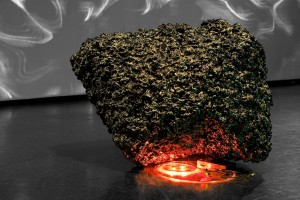
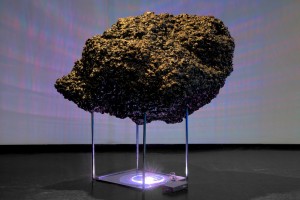 Geo Forms, polyurethane, metallic paint, steal and interactive LED lights
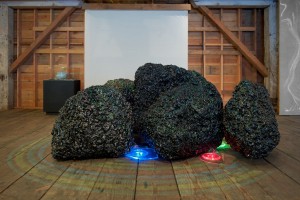 At the Gulf of Georgia Cannery Historic site, in the middle of the space, the five geologically-inspired polystyrene sculptures were clustered with a projection of water rings shining downwards onto the forms and reverberating out onto the wooden floor planks of the Cannery.
Multi Channel Video – Stories
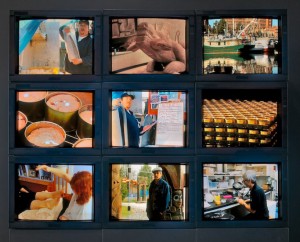 This multi channel video reflects the non-linear and artistic approach taken towards researching salmon, the ecological and economic catalyst of Canada’s West Coast region. It presents individual stories, and a collage of video excerpts culled from the interviews with Lleanna Clark, a reflexologist who worked as a cannery line worker at the Gulf of Georgia Cannery in high school; Jim Hart, a Haida Gwaii carver; Gerald Worobetz, a chef, fishing guide and home economics teacher at a local high school; Jeff Mikus, a commercial fisherman and restaurant owner; Kathryn Ricketts, an interpretative dancer and educator; Dr. Anthony (Tony) Farrell, Professor of Biology at UBC; Una McPherson, Head Interpreter at the Gulf of Georgia Cannery, who lived in cannery housing; Neil Jensen, a sports fisherman who worked on commercial fishing boats as a youth and grew up in Steveston; and Ben and Elli Answerth, young tourists from Australia. People of various cultural and professional backgrounds were sought out to create a complicated and kaleidoscopic view of the region.
Note: Videos will be added to this page soon.